
English| EUR
Suggested for you
More currencies
Choose a language
Rome sits roughly 240 kilometres north of the buried city, close enough for a single long day and far enough that the details matter. This how to get to pompeii from rome guide sets out the realistic options — rail, road and organised transfer — and the timing that decides whether the ruins feel calm or crowded. It also explains where the Amalfi Coast fits, if you plan to continue south.
Quick answer
Pompeii lies about 240 km south of Rome, reached in roughly two and a half to three hours door to door by high-speed rail via Naples, or three hours by road. The site entrance is Via Villa dei Misteri, 2, 80045 Pompei NA, and opens daily at 09:00, so aim to arrive between 09:00 and 10:30 to avoid peak crowds and midday heat.
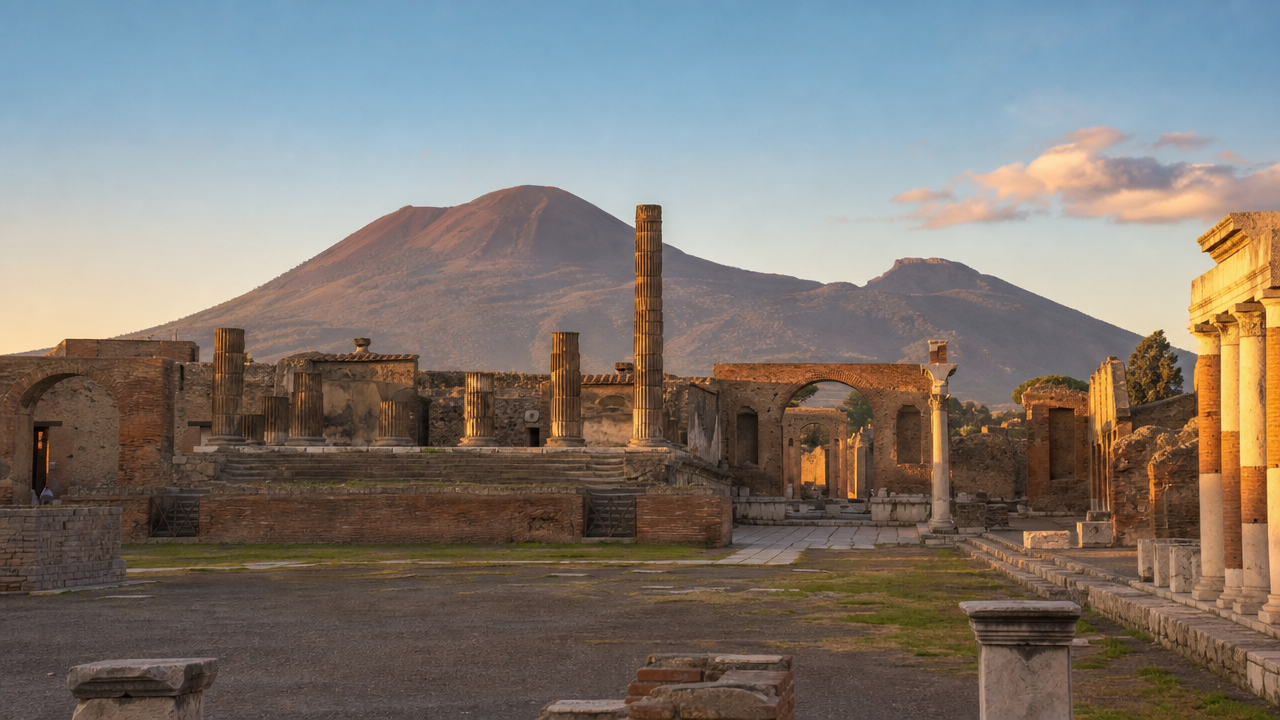
Pompeii was not lost slowly. In AD 79 a column of ash and pumice from Vesuvius sealed a working port town of some 11,000 people within roughly eighteen hours, preserving loaves in ovens, election graffiti on street walls, and cart ruts worn into basalt paving. What survives is not a monument but a municipality — 66 hectares of it, of which about two thirds has been excavated. Understanding that scale is the first practical step in working out how to get to pompeii from rome, because arrival time and remaining daylight matter more here than at any single museum. The reader is dealing with distance rather than difficulty. Rome to the Bay of Naples is a well-served corridor: high-speed services run frequently to Napoli Centrale, and regional connections continue to the two stations that serve the excavations — Pompei Scavi–Villa dei Misteri on the Circumvesuviana line, beside the Porta Marina entrance, and Pompei on the mainline for the modern town. Road travel covers the same ground on the A1 and A3 autostrade. The choice is less about speed than about what happens after the ruins. Travellers treating this as a straight archaeological visit tend to favour rail. Those combining the scavi with Sorrento, Positano or the Amalfi Drive usually want a vehicle waiting, because the coastal road's hairpins and summer traffic do not forgive a missed connection. A guided rome to pompeii day trip resolves that tension by fixing both legs in advance. Context explains why the early hours carry so much weight. The site is largely unshaded, its streets radiate stone heat through August afternoons, and the walk from Porta Marina to the Amphitheatre and back is several kilometres over uneven Roman paving. Guides and archaeologists working the Regio V excavations start early for the same reason visitors should. Gates open at 09:00 daily, and the first ninety minutes are measurably quieter along Via dell'Abbondanza, in the House of the Faun, and at the Stabian Baths. Use the answer as a scheduling tool, not a checklist. Decide first whether Pompeii is the day's destination or its opening act, then work backwards from a 09:00–10:30 arrival to a departure time from Rome. Anyone still weighing which of the Naples-area landmarks to prioritise — Herculaneum, Vesuvius, or the Amalfi Coast villages — should settle that question before booking, since it determines the route far more than the timetable does. The sections below break down each leg in detail.
“Rome to Pompeii is a question of distance, not difficulty — what you decide is not the route but what follows it.”
Pompeii is located in the Campania region, south of Naples. The most efficient route involves a high-speed train connection from Rome followed by a local transfer.
Frecciarossa or Italo from Roma Termini to Napoli Centrale
Circumvesuviana line from Napoli Piazza Garibaldi to Pompei Scavi
A1 motorway towards Naples, then A3 motorway towards Salerno, exit Pompei Ovest
Private transfer from Rome city center directly to the Pompeii entrance
For the best experience, arrive between 09:00–10:30 to avoid peak crowds and midday heat. The primary entrance is located at Via Villa dei Misteri, 2.
This plan suits travellers based in Rome who want to combine the excavations with an afternoon on the Amalfi Coast in a single long day, running roughly 14 to 15 hours door to door. It assumes an early start and a disciplined watch, since the coastal drive is the least flexible part of the day.
Depart the city centre before the morning rush so the arrival window at Pompeii holds. Build in a buffer for the last stretch into Pompei, where traffic tightens near the site.
Reach Via Villa dei Misteri, 2 within the 09:00-10:30 arrival window, when queues are shortest and the heat is manageable. Allow 15 to 20 minutes between arriving and actually walking through the gate.
Start at the Forum with the basilica, the Temple of Apollo and the Granai del Foro, then follow Via dell'Abbondanza east. Around 60 minutes, and the open Forum has almost no shade.
Take in the House of the Faun and the House of the Vettii, then cut south to the Teatro Grande and the Quadriportico. Roughly 75 minutes of steady walking on uneven basalt paving.
Choose one endpoint rather than both: the Amphitheatre and Great Palaestra in the east, or Villa dei Misteri near the exit. Each adds about 45 minutes including the walk back.
Eat near the site entrance and refill water before leaving. Keep this to 45 minutes, since the coastal road ahead is slow.
Arrive on the Amalfi Coast for around three hours: the descent through Positano to Spiaggia Grande takes 20 minutes on foot, and the climb back up takes longer.
Start back toward Rome in the early evening. Expect a late arrival and plan nothing for the following morning.
The best arrival window is 09:00–10:30, as arriving during this period avoids peak crowds and the midday heat. Planning your visit for these hours ensures enough time to explore the site before continuing your journey toward the coast.
Mild temperatures (15°C–22°C). Pleasant conditions for extended walking tours of the ruins.
Hot temperatures (25°C–32°C). High heat requires early arrival to avoid the intense midday sun.
Mild temperatures (16°C–24°C). Consistent weather makes these months ideal for balancing travel and exploration.
Cool temperatures (5°C–14°C). The site is quiet, though rain is more frequent during this period.
Verdict: Tuesday to Thursday, arriving between 09:00–10:30, during the months of April or October provides the most favorable balance of weather and crowd levels.
The archaeological site of Pompeii maintains consistent operating hours throughout the week.
Work through these steps in order, starting a few weeks out and finishing the morning you travel.
Everything you need to know about how to get to pompeii from rome
Travelers often ask how to get to pompeii from rome, with high-speed rail options to Naples followed by a local connection being the most common method. Many visitors choose to simplify their transit by booking a curated Rome to Pompeii day trip.
You can arrange a guided experience that covers logistics, allowing you to focus on the archaeological site rather than transit schedules. Many providers offer this for those wondering how to get to pompeii from rome without navigating local trains.
Travel time varies by transport mode, typically ranging from two to three hours each way. When planning how to get to pompeii from rome, consider the total duration including transfers to the site entrance.
While standard admission is 20 EUR, booking through an official partner or tour operator can facilitate entry processes. These options are popular for those seeking a seamless visit to this UNESCO World Heritage site.
The best arrival window is 09:00–10:30, as this allows you to explore the ruins before the peak midday heat. Planning your arrival carefully helps you maximize your time among the ancient structures.
Combining these locations requires careful coordination of transport, often best achieved via organized excursions. Since many people search for how to get to pompeii from rome while also planning coastal visits, integrated itineraries provide the most efficient route.
Trains offer a balance of speed and cost, while private transfers offer convenience and door-to-door service. Your choice depends on your budget and preference for independent versus guided travel.
Pack comfortable walking shoes, a hat, and plenty of water for your day trip. Navigating the cobblestone streets of this historic landmark is much more pleasant when you are prepared for the summer Mediterranean climate.